// SAP S/4HANA Transformation

Johannes Schulz
“We are too complex for the public cloud” – one of the most expensive sentences in S/4HANA transformation
Most companies that declare in the steering committee “We are too complex for the public cloud” actually mean something completely different: We do not want to change. And that is an entirely different discussion – with entirely different consequences.
We have heard this sentence in countless Cloud Steering Boards over the past few months. Usually, it comes early in the discussion. Usually, it comes from a person with authority – Head of SAP, IT Director, Board Member. Usually, everyone else nods.
A few months, plenty of slides, and a few workshops later, the decision is made: Private Cloud. Supposedly for rational reasons. In fact, out of a single instinct.
The cost difference between a public cloud strategy and a private cloud strategy can quickly add up to millions over just a few years. And yet, this decision is made in many companies before anyone has seen even a hint of a data-driven analysis.
The reflex: Everyone considers themselves a special case
In over three decades of SAP consulting, we have observed a pattern that astounds us every single time: plenty of project teams, IT departments, and companies are convinced they live in their very own complexity bubble. Everyone is the special case. Everyone has “their specific requirements.” Everyone says: “Things are different with us.”
Of course, there are differences between companies. But astonishingly often, the challenges are much more similar than assumed. The actual complexity rarely arises from the business itself – but rather from years of Customizing, custom logic, and grown exceptions.
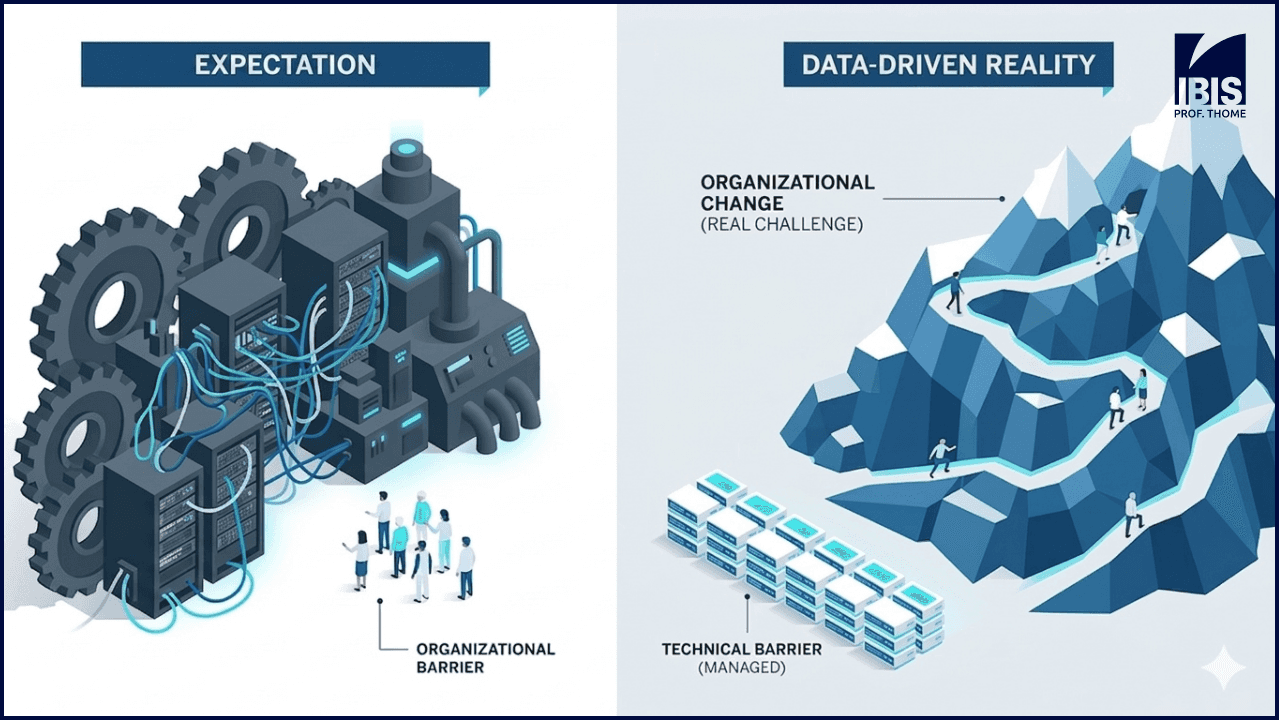
It becomes interesting the moment data-driven analyses show that a majority of the processes are already very close to the SAP Standard. This is because exactly this realization initially meets with resistance in many steering boards. Not for functional reasons – but because it contradicts the organization's long-established self-image.
Exactly this reflex is the problem. Because it blocks the view of a very important distinction.
There are two types of “does not fit”: One is real, the other is habit
When a company says “We do not fit into the public cloud,” it often means two very different things – and blends them into one statement. This is the crucial misconception.
Hard showstoppers – these must be respected:
Functionalities that simply do not exist in SAP Cloud ERP (formerly S/4HANA Public Cloud). For example, non-ferrous metal processing has still not been adequately mapped there. Those who shape large parts of their value creation with it have no room for maneuver.
Specific Industry Solutions that are not (yet) included in the public cloud model.
Certain regulatory, tax, or industry-specific constellations for which the SAP Standard demonstrably offers no solution.
These are facts, not opinions. They are rare, they are hard, and when they apply, there is nothing to discuss.
Soft topics – this refers precisely to those points that are defended with the greatest fervor in cloud workshops. At first glance, they look like complexity; at second glance, they are usually something else:
Four different sales organizations, each with its own document type logic (“historically grown, we need it all”).
Release strategies for purchase orders that no one has questioned since 2011.
Z-transactions that a power user had built ten years ago for a special case – and without which supposedly “nothing works anymore” today.
Master data maintenance that happens in five areas in parallel and according to its own rules in each case.
Shadow workflows in Excel that officially do not exist.
These are not showstoppers. These are organizational decisions that were useful or pragmatic at a certain point in time – and that are sold today as complexity.
The honest question is: How large is the hard portion of what you consider non-negotiable?
Our experience from real system analyses: Frequently, the proportion of genuine showstoppers is surprisingly small compared to what is marked in the workshop as “cannot go away.”
Why SAP is right on many points
Despite all skepticism: SAP did not change course on the cloud question out of pure marketing interest. The arguments are real:
Faster innovation cycles through automated updates
Reduced in-house effort in operations, patching, and upgrades
Clearer architecture and thus a more sustainable foundation for AI and automation scenarios
Standard processes that have indeed become Best Practice in many industries
For a substantial proportion of SAP users, SAP Cloud ERP can be the strategically right path:
More than most companies currently believe.
Fewer than SAP would like.
The truth does not lie in a generalized statement – but rather in the concrete system reality of each individual company.
The five honest dimensions of a cloud evaluation
Instead of relying on gut feeling, it is worth taking a sober look at five factors that actually determine a system's cloud readiness:
Proximity to SAP Standard: How far does the system actually deviate from the designated standard? Not based on feeling. But measurable.
Complexity of business processes: How many variants, exceptions, and individual logics exist – and how often are they actually used?
Integration complexity: How closely is the system linked to third-party systems, data flows, and external logics?
Functional specialization: Which parts of your business model truly require non-standardized solutions – and which only do so out of habit?
Complexity of corporate management: How individually are financial logic, organizational structure, and management mechanisms actually mapped?
Each of these points can be evaluated based on data. Not guessed. Not estimated in a workshop. Measured.
What remains when you measure honestly
The cloud decision is one of the most central strategic courses of action in the coming years. It should not be the result of a workshop atmosphere. It should be the result of an honest finding.
Those who approach the evaluation in a data-driven manner frequently experience two surprises at the same time:
The number of genuine showstoppers for a public cloud strategy is smaller than expected.
The organizational readiness for change that a transition would require is larger than expected.
Both are important insights. Both fundamentally change the strategic discussion – because they shift the discussion from gut feeling to fact-based evaluation.
If you had to answer the five dimensions for your system honestly, based on data and without workshop folklore: How many of your “indispensable custom processes” would be left in the end?
In order to enable exactly this honest evaluation, IBIS Prof. Thome developed the Cloud Decision Framework based on its long-proven RBE Plus methodology. We analyze your actual system reality along the five central evaluation dimensions and deliver an objective, comprehensible picture of your cloud readiness – with a clear separation between hard showstoppers and soft topics. In this way, “Things are different with us” becomes a resilient finding with which a million-dollar decision can be securely and pragmatically backed.
The featured image was generated using AI.

