// SAP S/4HANA Transformation

Johannes Schulz
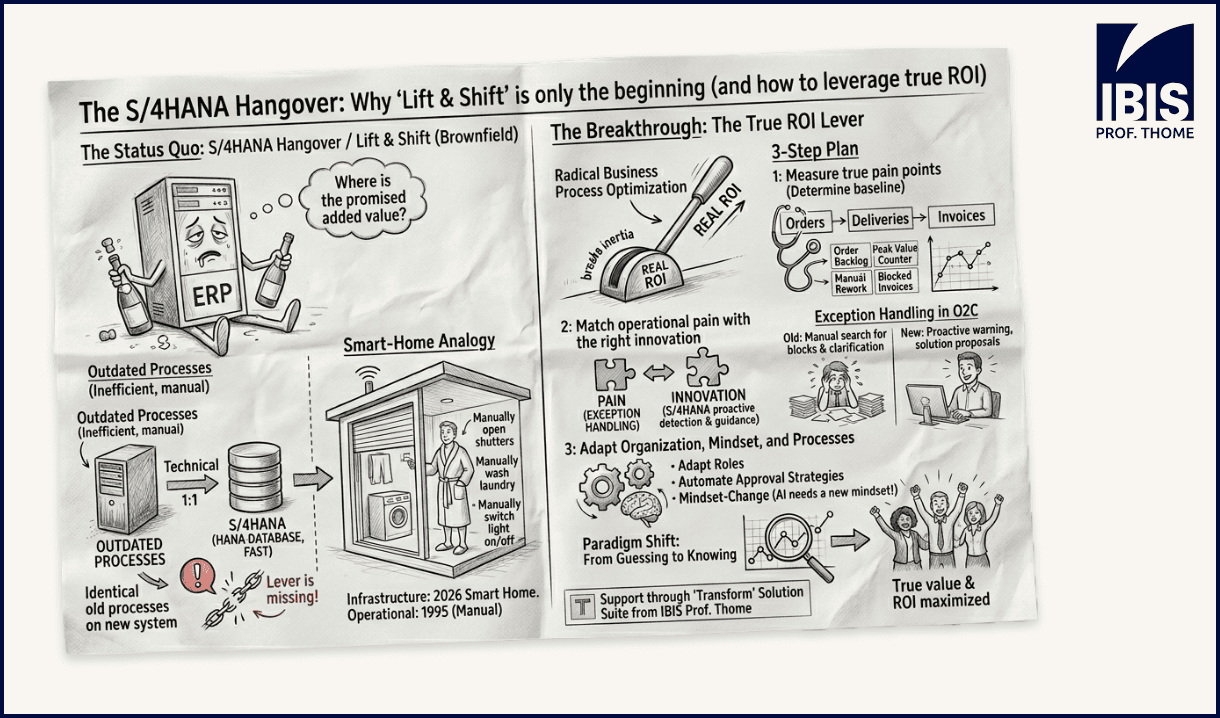
The S/4HANA Hangover: Why a "Lift & Shift" is just the beginning (and how to leverage true ROI)
"We are live on S/4HANA!" – The corks pop, the project team celebrates, and the IT department pats itself on the back. But six months later, the CFO asks during a management meeting, a little bit disillusioned: "So, where exactly is the promised added value for our business?"
If this real-world scenario sounds familiar, you are definitely not alone. Driven by risk aversion, time pressure, or tight budgets, many companies choose the path of least technical resistance when transitioning to the new ERP generation: the so-called "Lift & Shift" (the classic brownfield approach).
The system is technically lifted one-to-one onto the new, extremely fast HANA database. The project is "in time, in quality, and in budget." All technical lights are green. But on a functional level, for the users in the business departments, almost nothing changes.
The psychological trap of the IT-driven upgrade
The fundamental problem with this approach: If you simply copy old, historically grown, and inefficient processes into a new system, you end up with exactly the same old, inefficient processes. Just on a much more expensive and faster database.
Imagine moving from an old, drafty house into a state-of-the-art, perfectly networked smart home. The infrastructure is incredible. But instead of using the automatic climate control, the connected appliances, and the energy management system, you wash your clothes without any energy benefits, open and close every blind by hand, and turn on every light switch manually.
In its presentations and marketing materials, SAP loves to promise that everything will be better, faster, more transparent, and more intelligent with S/4HANA. However, the harsh reality of transformation projects teaches us: In most cases, this massive business value is not created simply by "switching on" the system. It usually has to be actively desired, identified based on data, and procedurally anchored within the organization.
The illusion of automatic improvement
A technical upgrade merely modernizes your IT infrastructure. It does not automatically optimize the way your buyers, controllers, or sales reps work. New capabilities, AI-supported workflows, Fiori apps, and intelligent automations often lie dormant and unused for weeks or months in the S/4HANA systems of most "Lift & Shift" customers.
The reason for this is simple: No one in the business departments knows that these new features exist—or how to apply them profitably to their own individual problems. If you want to harness the true potential and the real ROI of your new ERP generation, you must drastically shift gears after the "dirty" Lift & Shift: away from a pure IT operations view, towards radical, business-driven process optimization.
The 3-step plan after Lift & Shift: from operations to value creation
So, what exactly should companies do once the dust of the technical migration has settled and the system is running stably? How do you move from a pure "Run" mode to real value creation?
Step 1: Measure the real pain points (Establish a baseline) Before you blindly start activating new S/4HANA features in the system, you must ruthlessly expose where your company is currently bleeding operationally. Never rely on outdated process manuals or the gut feeling of department heads. Analyze the real data in the system. Where are orders piling up? Where is there massive manual rework? Where are deadlines being missed?
Step 2: Match the operational pain with the right innovation Once you know exactly where the process is getting stuck, you need to deliberately check: Which specific S/4HANA innovation was developed precisely for this problem? It’s not about turning on everything S/4HANA has to offer. It’s about utilizing the exact capability that resolves the identified problem.
Step 3: Adapt the organization, mindset, and processes A new, intelligent feature won't yield a single cent in profit if the organization doesn't follow suit. Work instructions, role concepts, approval strategies, and the mindset of the employees must be adapted to the new, automated standard processes of the S/4HANA system. The best AI is useless if the clerk still ends up printing out the decision and filing it in a folder.
A deep-dive practical example: exception handling in Order-to-Cash (O2C)
Let’s make this abstract approach tangible with a very concrete example from Sales.
In many classic SAP ECC systems, handling exceptions is a massive time sink and a true margin killer. Sales orders run into delivery blocks due to unclear data, invoices receive automatic payment blocks, or orders have to be manually stopped, clarified, and recreated due to missing credit checks.
The operational reality then looks like this: highly qualified resources are kept busy identifying and routing these transactions. They manually search for blocked documents, chase down the root causes over the phone in other departments, and finally resolve the blocks manually in the system. This process is error-prone, extremely slow, and frustrating for employees and customers alike.
With S/4HANA, SAP provides intelligent "Exception Handling" functions for this. Problems are proactively detected and brought to the attention of the appropriate users before they escalate. The clerk is provided with potential solutions right at their fingertips and doesn't have to search for them manually.
The crucial question, however, is: Are you already using it?
It is precisely at this intersection that the wheat is separated from the chaff among S/4HANA users. It's not enough for IT to report in the steering committee: "The system can do that." We have to link the real pain to the concrete solution.
If a sound, data-driven analysis of your system usage shows that your company sets and resolves 15,000 manual payment blocks a month or manually touches 4,000 orders due to credit checks, then the pain point is massive. Working capital is tied up, customers are dissatisfied, and employees are overloaded. In that exact moment, S/4HANA Exception Handling is no longer an abstract "nice-to-have" feature from a slide deck—it becomes a tangible, strategic business case.
The paradigm shift: from guessing to knowing
Instead of overloading the SAP system with new features using a scattergun approach and overwhelming the organization, we must proceed in a highly targeted manner. We must answer two questions based on data:
Do we, based on our current system and process usage (high number of cancellations, payment blocks, manual interventions in specific plants or company codes), even have a tangible need for this specific innovation?
If so: have we already technically activated this innovation in the S/4HANA system and – more importantly – are we consistently using it in our day-to-day operations?
Only through this precise alignment of the "as-is state of the problem" and the "availability of the S/4 innovation" does a purely technical Lift & Shift become a true, value-generating business transformation.
Are you currently still stuck in the "Lift & Shift" hangover, or are you already leveraging the true added value of your massive S/4HANA investment?
To uncover exactly these hidden potentials in your system based on data, the team at IBIS Prof. Thome supports you with the "Transform" solution suite. We analyze your actual system reality, automatically match your operational pain points with the appropriate S/4HANA innovations, and show you exactly which capabilities you need to activate to maximize your ROI and thrill your business departments.
The featured image was created using AI.

