// Efficiency analysis

Johannes Schulz
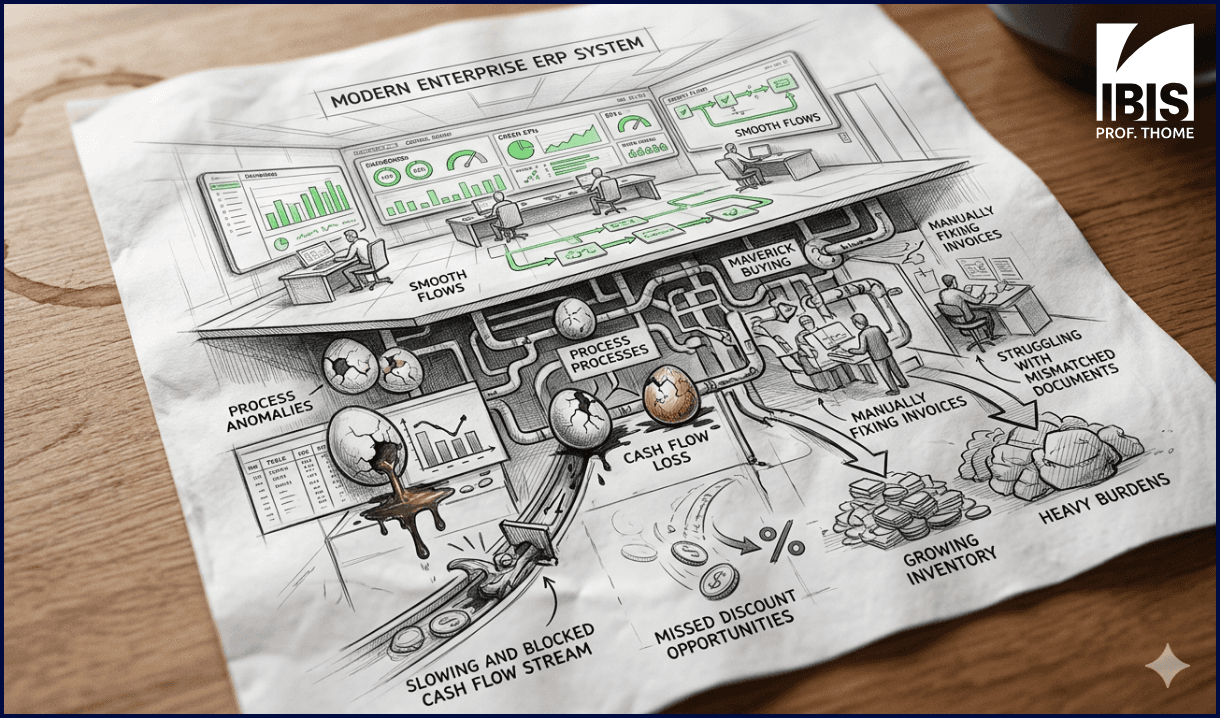
Hidden “Easter Eggs” in SAP: How to Find the “Bad Eggs” in Your Processes and Protect Your Working Capital
An Easter egg hunt is as much a part of Easter as the chocolate bunny—but in your ERP system, searching for hidden anomalies is a costly nightmare. If your aggregated dashboards show green numbers but cash flow is stagnating, for example, it’s high time to identify the “rotten eggs” in your processes.
The aggregated data in management reports often paints a picture of a perfect world. On the surface, processes run smoothly; the so-called “happy path” seems to be the norm. The reality deep within SAP systems, however, often looks quite different. Individual organizational units, departments, or stakeholders develop their own ways of working. Deviations, workarounds, and shadow processes emerge that initially remain invisible in the big picture—until they secretly show up on the balance sheet. The problem: These hidden process anomalies cost real money every day.
The Illusion of the “Happy Path” and the Cost of Invisibility
The barrier to deviating from standardized SAP processes is often alarmingly low in the hectic day-to-day work environment. When the standard process is perceived as too rigid or too slow, employees look for shortcuts. What begins as a pragmatic solution to an acute problem quickly evolves into a systemic risk.
Without deep, data-driven process transparency, teams tend to solve problems through manual interventions rather than addressing the root cause within the standard process. The result is a bloated process landscape riddled with inefficiencies that tie up working capital and undermine operational excellence goals.
A real-world example: The high cost of perceived speed
To make complex process anomalies tangible, let’s consider an everyday scenario from the Procure-to-Pay (P2P) domain:
An employee urgently needs a material and orders it bypassing the official procurement processes. The motivation behind this is often positive: it’s supposed to be “faster and cheaper.” However, the systemic reality of this maverick buying looks devastating:
Purchasing may have to enter the order into the system retroactively and process it manually.
Accounting receives an invoice without a direct purchase order reference (PO match) and must laboriously search for the approval.
Finance suffers because the invoice remains pending during this clarification process. The cash discount period often expires unused.
What appeared, viewed in isolation, to be a quick solution for the employee ultimately takes significantly longer for the company as a whole. Operational effort skyrockets, lead times lengthen drastically, and direct financial savings potential (such as cash discounts) fall by the wayside unused. A classic “bad apple” in the process.
How bad apples poison the Cash Conversion Cycle (CCC)
Process anomalies are not isolated IT problems; they are direct attacks on corporate liquidity. If we look at the Cash Conversion Cycle, for example, anomalies affect all three central pillars:
Days Sales Outstanding (DSO): Missing reconciliations from Sales to Accounting result in invoices being created in Sales but not posted in Financial Accounting. Revenue is visible operationally but a ghost in accounting. The result: delayed invoicing, later receipt of payments, or difficult payment allocation, leading to longer DSO.
Days Payable Outstanding (DPO): As in the example above, manual rework on invoices prevents payment terms from being strategically utilized. When payments are blocked due to clarification issues or payment approvals are bypassed, the company loses control over optimal cash outflow.
Days Inventory Outstanding (DIO): Unauthorized excess deliveries, which are automatically accepted due to overly permissive system settings, inflate inventory levels. Inventory management loses its buffer function and becomes a capital trap. Every day that material sits unnecessarily in the warehouse ties up liquidity that is lacking elsewhere.
Compliance Risks and Waste of Resources
In addition to the direct financial impact, process anomalies have far-reaching consequences for governance and internal resource allocation.
Traditional control mechanisms are designed for the “happy path.” When processes deviate due to manual interventions, audit risks arise. Manual payments can bypass existing payment blocks in the system. A lack of duplicate checking during invoice entry opens the door to duplicate payments. Such erroneous patterns propagate and make the risk systemic.
At the same time, internal resources suffer. Analysis of process anomalies often reveals that highly qualified finance teams spend a significant portion of their time, for example, correcting price discrepancies in customer orders, resolving technical errors, or manually processing erroneous goods receipts. This loss of productivity is a costly waste of expertise.
What this means in practice
If you do not actively manage process anomalies in your systems, the negative effects accumulate:
More effort, less value creation: A growing portion of operational working time is spent repairing standard processes instead of on value-adding activities.
Faster spread of errors: Tolerated workarounds become the new norm. A single error in master data leads to hundreds of faulty business transactions.
Jeopardized external relationships: Late goods receipt postings or canceled invoices do not remain internal. They lead to delivery delays and frustration among customers and suppliers, which causes lasting damage to your image.
Audit and compliance gaps: Weak authorization patterns and a lack of traceability in manual interventions conflict with regulatory requirements and internal control systems (ICS).
From symptom to root cause: The value of root cause analysis
Knowing that anomalies exist in your systems and where they are roughly located is an important first step. But to solve the problem sustainably, it is not enough to simply count symptoms. We must dig deeper into precisely these areas to identify the actual root cause and thus the most effective lever for optimization.
Where exactly does the error occur? To find that out, we filter the anomalies by their true drivers:
Organizational level: Does the anomaly occur frequently in a specific company code, a particular plant, a single sales organization, or even among specific employees?
Master data: Are certain suppliers or customers the actual triggers? A classic example: A customer may purchase goods worth only 1,000 euros, but returns 900 euros’ worth of them. Calculated across the entire company, the return rate may seem unremarkable, but relative to its specific population, this very customer is a massive cost driver and the cause of a disproportionate amount of manual effort.
Configuration or Customizing: Can the deviation be traced back to a specific identifier, such as a particular document type or item category, that systematically misdirects the process in the background?
Only when we establish this proportionality and isolate precisely the entity that is disproportionately responsible for a process anomaly can we specifically remedy the process.
The Paradigm Shift: From Guessing to Knowing
To resolve this invisibility, we must fundamentally change the way we manage processes. Away from pure gut feelings and interviews, toward hard, data-driven facts from the SAP system.
The formula for a “Clean Core” in your processes is:
Eliminate: We must consistently identify and stop issues such as manual rework, maverick buying, and unnecessary additional postings.
Standardize: Processes must be returned to their intended, efficient paths to ensure data quality and compliance.
Accelerate: The throughput times of the streamlined, automated standard processes must be accelerated to maximize working capital relief.
We must make process anomalies measurable. Not through estimates, but by analyzing the actual digital footprints in the systems. Only when we know exactly where the process is faltering can we intervene specifically and protect cash flow.
Easter is a good opportunity to start looking. But do you actually know how many of your processes are already running “in the shadows” today, tying up your capital unnoticed?
Identifying hidden inefficiencies requires the right methodology. The IBIS Prof. Thome team supports you with the Optimize analysis to bring data-driven transparency to your SAP processes, track down bad apples, and ensure your operational excellence in the long term.

