// SAP S/4HANA Transformation

Johannes Schulz
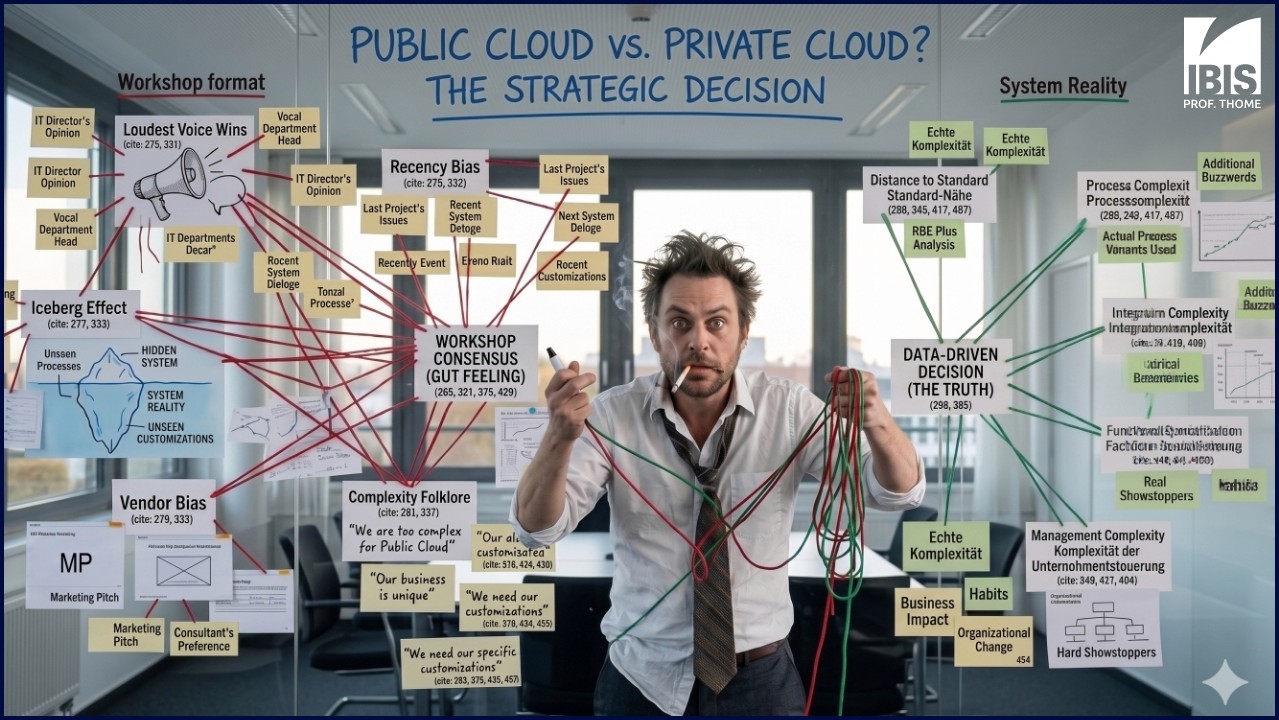
Public Cloud or Private Cloud? If you’re deciding that in a workshop, you’ve already lost.
The next S/4HANA workshop at your company will undoubtedly produce a result. The only question is: does it reflect your system reality – or just the opinion of the loudest person in the room?
The decision between SAP Cloud ERP (S/4HANA Public Cloud) and SAP Cloud ERP Private (S/4HANA Private Cloud) is one of the most expensive strategic choices organizations using SAP will make in the coming years. It dictates your architecture, degree of standardization, innovation capability, operating model, licensing logic, and vendor lock-in for the next decade.
And yet, in practice, this million-dollar decision is typically made in a way that most companies wouldn’t even use to approve their next marketing campaign.
How this million-dollar decision actually gets made
Anyone who listens in on cloud steering committees at larger SAP customers will notice a recurring pattern:
Workshops with internal IT leadership and selected business unit representatives.
A handful of slides from the implementation partner featuring pros and cons.
A vendor pitch from SAP, naturally favoring a particular outcome.
A peer benchmark slide (“Other companies in our industry chose option X”).
A gut-feeling decision disguised as consensus.
The result is a PowerPoint proposal that no one challenges anymore – not because it’s fundamentally sound, but because the energy for discussion has been exhausted.
Compare that to the decision-making basis you would require for an investment in a new production line, an acquisition, or the construction of a logistics center. Those involve financial modeling, due diligence, sensitivity analyses, and external expert opinions.
The investment volume and strategic weight of an SAP cloud strategy are comparable in many large organizations. The quality of the decision-making basis often is not.
Why workshops are structurally ill-suited for this question
This is not a criticism of the workshop format itself. Workshops are excellent for forming hypotheses, aligning teams, and exploring options. They are simply not suited to accurately describing the reality of a complex SAP system and the processes within – for several structural reasons:
Loudest Voice Wins: Whoever speaks most persistently or sits highest in the hierarchy shapes the majority view – regardless of whether they actually know the system’s architecture.
Recency Bias: The most recent project, incident, or consulting engagement dominates perceptions of complexity – even if it’s strategically insignificant.
The Iceberg Effect: The people in the room typically know only a small fraction of what is actually running deep within the system. The rest remains invisible – and therefore unassessed.
Vendor Bias: Whoever facilitates the workshop usually has a stake in the outcome. Even with well-intentioned consultants, the framing naturally shifts.
Complexity Folklore: Over time, statements like “our setup is especially complicated” solidify into deeply rooted beliefs – without ever being tested against data.
The result is not necessarily that workshops produce “wrong” answers. The result is that they produce answers that cannot be verified. And for a decision of this magnitude, that is simply not enough.
The data already exists — inside the system itself
What’s truly remarkable about this discussion: the most reliable data for answering the cloud question has always been right where it’s always been – inside the company’s SAP system. Every transaction, every customizing entry, every document, every process variant, and every integration leaves a digital fingerprint.
What is merely opinion in the workshop is fact in the system:
How close is your customizing to the SAP standard? Measurable.
How many process variants actually exist in your order-to-cash flow – and which ones are actually used? Countable.
How tightly coupled are your interfaces, and where do the critical dependencies lie? Mappable.
What share of your business processes genuinely deviate from the standard – and which ones only feel that way? Assessable.
How complex are your financial logic, organizational structure, and management mechanisms really? Analyzable.
These five dimensions — distance to standard, process complexity, integration complexity, functional specialization, and management complexity – are the honest foundation of any cloud assessment. They are not discussion points. They are data points.
From workshop outcome to defensible findings
The difference between a workshop-driven and a data-driven cloud decision is not a matter of degree. It is categorical.
A workshop decision produces a recommendation – with the implicit fine print: “To the best of our knowledge, based on the input of whoever happened to be in the room, accounting for whichever aspects someone happened to think of.”
A data-driven decision produces a finding – with the explicit fine print: “Based on all relevant system information, assessed in a reproducible way, with clearly stated assumptions and a transparent chain of reasoning.”
One is just a presentation you hope the board accepts. The other is a fact-based business case you can confidently defend.
From Guessing to Knowing: The real promise of a cloud strategy
This question is not ultimately about whether you end up migrating to the Public Cloud or the Private Cloud. Both paths are right – for different companies, in different situations, for different reasons. There is no universally “better” answer.
What matters is how you arrive at your answer. And whether that answer holds up under scrutiny – from the board, from auditors, from the steering committee, or simply from the reality that will test your assumptions a few years down the road.
Would you make an investment of this magnitude – with implications for a decade of architecture, innovation capability, and operating costs – on the basis of a two-day workshop in any other area of your business?
That is exactly the question that led us to develop the IBIS Cloud Decision Framework. Building on our long-established RBE Plus methodology, we analyze your system across the five core assessment dimensions, derive a consistent evaluation with a clear and transparent scoring logic, and thereby create the robust decision-making foundation that a cloud strategy deserves.
Stop guessing, start measuring. Let’s turn your workshop consensus into a defensible finding — so your gut-decision becomes an investment with a solid, data-driven footing.
The cover image for this post was generated using AI.

