// SAP S/4HANA Transformation

Felix Fleischmann
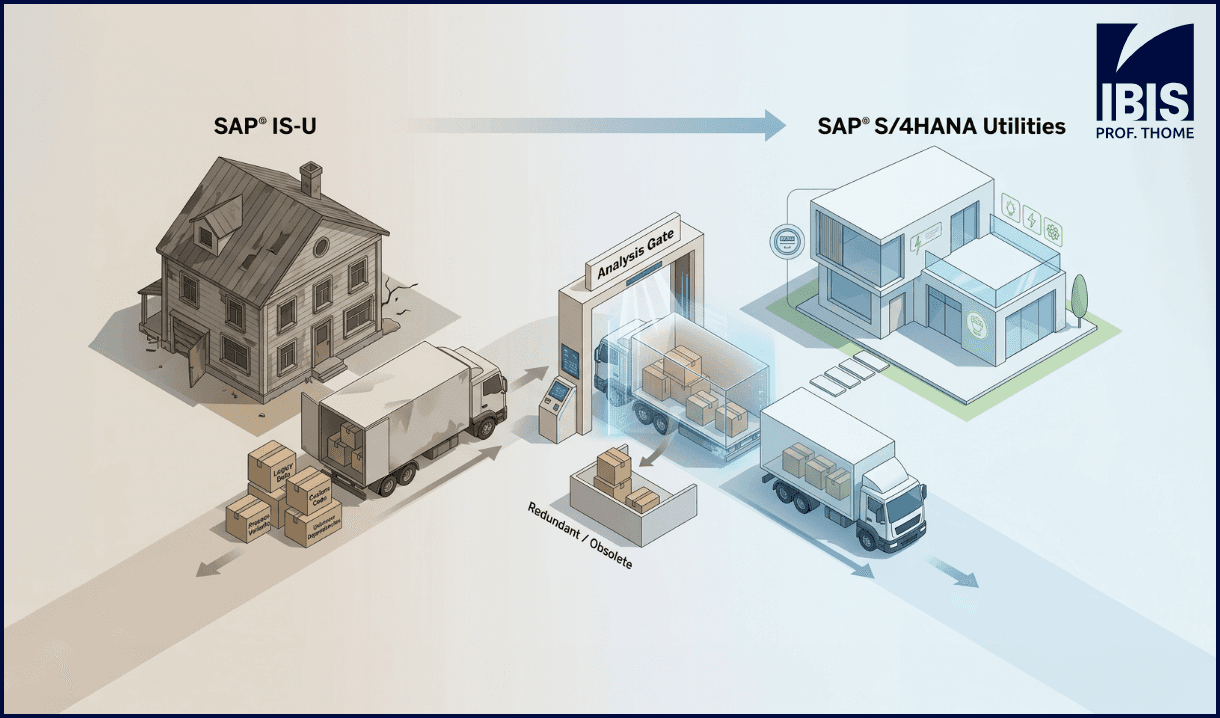
The most expensive move in the energy industry: Why transparency is critical for your SAP S/4HANA project – and how to declutter the basement first.
Imagine you have saved and planned for years and are now finally building an ultra-modern, energy-efficient smart home. On moving day, however, you blindly pack all the junk from your old, damp basement into moving boxes and place it in your new living room without even looking at it. Sounds absurd?
Yet this is exactly the scenario currently playing out in the IT departments of countless utility companies. Data quality and the blind transfer of technical ballast are the biggest missing links in current SAP transformations.
The energy transition will not wait – but your legacy systems will not wait for SAP S/4HANA Utilities, either. It is time to take stock.
Current challenges for utility companies: The storm at the doorstep
The energy industry is facing one of the most profound technological and structural transformations in its history. It is no longer just about transporting electricity and gas from A to B. Due to the energy transition, the expansion of decentralized energy generation, smart grids, and the integration of prosumers, utilities must now operate more flexibly than ever before. New, data-driven business models, dynamic tariffs, and volatile markets must be integrated seamlessly into existing IT landscapes.
At the same time, an unforgiving clock is ticking for the central IT backbone of almost all major utility companies: the end of support for SAP IS-U is forcing the entire industry to make a mandatory transition to S/4HANA Utilities in the coming years.
What looks like a logical upgrade step on paper often becomes a risky and cost-intensive megaproject in practice. The reason? Historically evolved system landscapes, complex custom developments, and opaque data structures make cloud migration significantly more difficult.
The analogy: Your ERP system as a house that has evolved over decades
To make the magnitude of this problem tangible for IT decision-makers, let us stay with the moving analogy. Your current SAP IS-U system is like a large, solid house in which your company has lived for 20 years.
Over the years, a great deal has accumulated:
• When the standard kitchen was no longer sufficient, you had a custom cabinet built (your custom code).
• In the basement, tools are stored two or three times over because no one knew what someone else had already purchased (redundant data structures).
• Every family member has developed a different way to leave and lock the house in the morning (historically evolved process variants).
If you now move into your new S/4HANA Utilities smart home, you have two options: either you take everything with you (the so-called "Brownfield" approach without cleanup) and immediately make the new house cluttered again. Or you throw everything away and start completely from scratch ("Greenfield"), which often leads to massive resistance within the workforce and exploding project timelines.
The silent cost driver: Custom Code & data ballast
This is the uncomfortable truth for many project managers and CIOs: the main problem of transformation is not the new technology. It is your own process variants that have evolved over years and the technical ballast your system has accumulated.
These are the “rotten moving boxes” that blow up your budget:
• Hundreds of Customizing settings without documentation: You have tailor-made Z programs in the system, and today no one knows why they were programmed in 2012. No one dares to deactivate them for fear that a business-critical process will collapse. (Like a mysterious light switch in the house that one prefers not to press).
• Missing single source of truth: Customer data, asset information, and meter readings are stored in different silos. If data quality is not cleansed before migration, you merely digitize your existing errors.
• Process sprawl: If five different departments map the same business transaction in five different ways in the SAP system, friction losses arise. Often, no one has a complete overview of these process variants anymore.
• Hidden dependencies: Custom code often lies dormant and concealed. If an apparently unimportant program is omitted during migration, it can trigger fatal chain reactions in billing.
These are not purely IT problems. These are business processes that are actively getting in their own way.
The solution: System and process usage analysis
So how do you prevent the move from ending in chaos? You conduct a professional inventory before packing the first box.
This is precisely where the system and process usage analysis of IBIS Prof. Thome AG comes in. With in-depth analyses, we create unvarnished clarity before the actual migration project begins.
We shine a flashlight into every corner of your "SAP basement" and provide hard facts instead of gut feeling. Here is an excerpt:
1. Transparency across all processes: We make all active process variants visible. This allows you to see exactly which paths your employees actually take in the system and where standardization pays off immediately.
2. Custom Code: We separate genuine, value-creating custom code from technical ballast. You can see in black and white which custom developments are in use and which ones you can confidently "discard as bulky waste."
3. Quantification of optimization potential: We show you, based on data, which measures you can use to address your “pain points.”
Why transparency saves money, time, and nerves
A well-founded analysis before transformation is not a nice-to-have side project – it is insurance for your IT budget.
Through the transparency provided by the IBIS analysis, you drastically minimize typical project risks. You prevent surprises during the implementation phase because there are no hidden dependencies left. You make costs reliably plannable because you know exactly how large the migration effort is for the remaining, genuinely necessary custom code.
Above all, however, you protect the nerves of your entire project team and business departments. Because instead of discussing in endless workshops how a process is presumably executed, you discuss—based on objective system data—how it actually runs. You place your transformation on a solid, data-driven foundation—rather than on historical ballast.
Conclusion: Transformation begins in the mind (and in the basement)
For the energy industry, migration to SAP S/4HANA Utilities is the most important IT project of the decade. However, transformation does not succeed through the mere purchase of new technology. It begins with transparency and the strategic decision to consistently leave legacy burdens behind.
Those who professionally declutter their basement before moving not only move faster and at lower cost—they finally gain the freedom in their new smart home to truly realize the innovations of the energy transition.
📲 Hand on heart: If you look into your SAP basement today—do you know exactly which boxes you could discard unopened for the S/4HANA migration?

